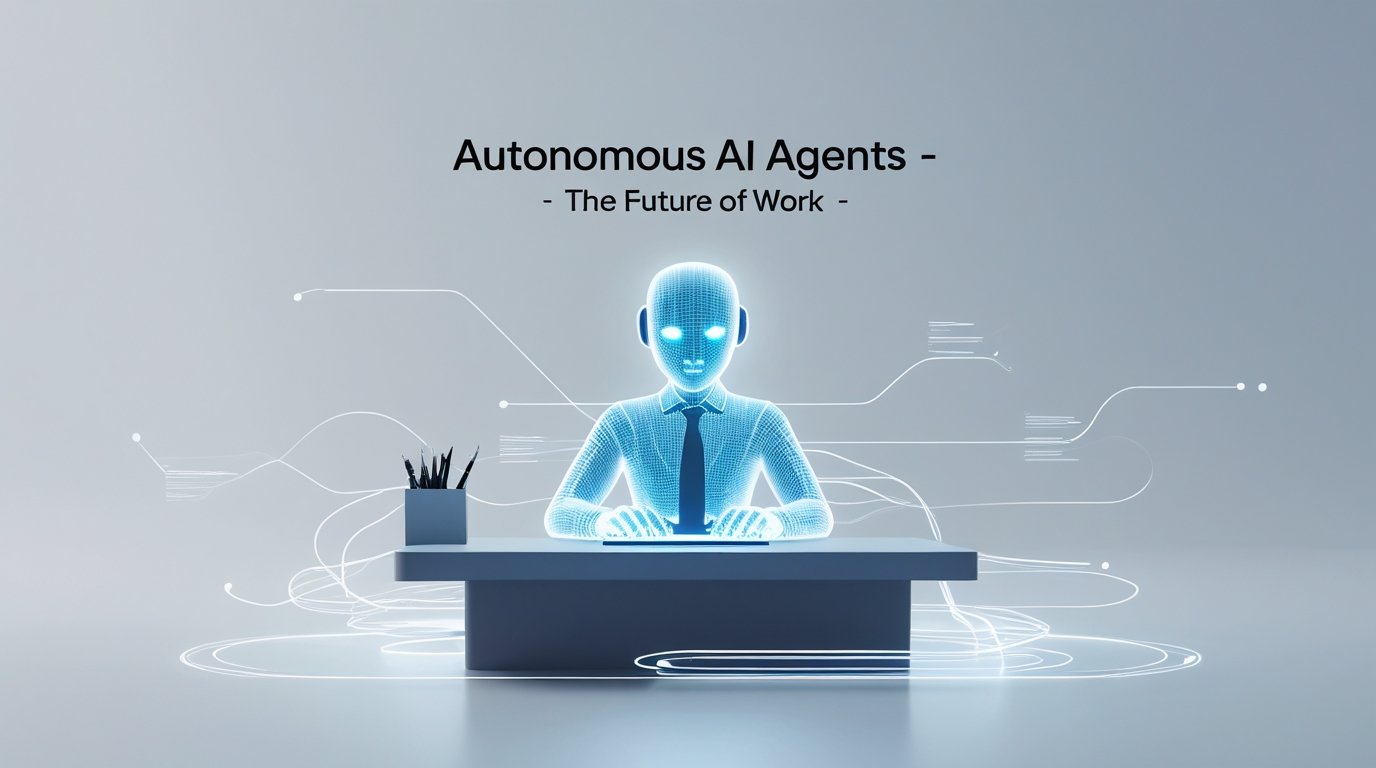
Let’s cut through the hype for a second. When you hear “Autonomous AI Agent,” what do you picture? A sleek, humanoid robot making executive decisions? A digital overlord managing your calendar with cold, perfect logic? Honestly, that’s a fantasy. And it’s distracting us from what’s actually happening, which is both more boring and far more revolutionary.
The real story isn’t about silicon bosses. It’s about digital interns. The future of work isn’t about AI replacing you. It’s about you being paired with a tireless, hyper-competent junior employee who doesn’t need sleep, doesn’t get bored, and can be copied a thousand times. This isn’t about the end of work. It’s about the end of the grunt work that fills the spaces between the moments we actually use our brains. Let’s talk about what that actually looks like on a Tuesday afternoon.
Meet Your New Junior Employee:
Forget the sci-fi. Think about the most tedious parts of your job. The parts you put off until 4 PM on a Friday. The parts that involve juggling twelve browser tabs, copying data from one system to another, and sending a dozen follow-up emails.
An autonomous AI agent is a program you can hand that exact task to. You don’t have to hold its hand. You give it a goal: “Compile the weekly sales report from the CRM, the Google Ads dashboard, and the Salesforce data, and email a summary to the team every Monday by 9 AM.”
And then it just… goes. It’s autonomous. It logs into the systems (it has its own little digital credentials). It fights with the weird login screen that pops up sometimes. It finds the data, figures out how to combine it, writes a passable summary, and sends it. It fails sometimes, sure. It might get stuck on a captcha. But it learns. And it never, ever complains that the task is beneath it.
This Isn’t Automation. It’s Delegation:
We’ve had automation for years. “If this, then that.” But that’s rigid. It breaks the second the process changes.
An autonomous agent is different. It’s built on a large language model, which means it can reason. It can handle ambiguity. Its core loop is shockingly human:
- Plan: “Okay, to get that report, I need to first log into the CRM. But the CRM is down for maintenance until 2 AM. So I’ll schedule that step for 2:15 AM.”
- Act: It executes the step. It clicks the buttons, navigates the menus.
- Observe: “Hmm, the login failed. Did I use the wrong password? Or is the site still down? Let me check the status page. Ah, it’s still down. I’ll wait 30 minutes and try again.”
- Repeat. It continues this loop until the goal is achieved or it truly gets stuck and pings a human for help.
This is a fundamental shift. You’re not building a Rube Goldberg machine of pre-defined steps. You’re giving an objective to a digital entity with a semblance of common sense and the ability to navigate a messy, unpredictable digital world.
The Real Impact:
Here’s who is first in line to get one of these digital interns. It’s not the CEO. It’s the middle manager. The marketing coordinator. The customer support lead. The people drowning in what I call “digital homelessness“, they have a dozen places they need to be online, a constant stream of notifications, and no single tool to manage it all.
- The Marketer’s Agent: Wakes up, checks the ad campaign performance, adjusts the daily budget based on the rules it was given, drafts a performance summary, and drops it in Slack.
- The Researcher’s Agent: Is given a topic. It spends the next 8 hours scouring the web, reading academic papers, summarizing them, and building a beautifully organized literature review in a shared document.
- The Sales Lead’s Agent: Monitors the CRM for new high-value leads, researches their company, pulls their latest news, and preps a one-paragraph briefing for the human sales rep before their first call.
These aren’t far-off ideas. The building blocks are here now. This is the quiet, unsexy revolution. It’s not about one AI doing a job. It’s about every knowledge worker having a personalized digital workforce.
The Human Job Becomes Conductor, Not Carpenter:
So what’s left for us? This is the scary part, but it’s also the exciting part.
Your job shifts from being the carpenter, the one who saws the wood and hammers the nails, to being the conductor. You’re not playing every instrument. You’re leading the orchestra.
Your value is no longer in how you execute a task, but in what tasks you choose to delegate and what goals you set. It’s about strategy, creativity, and human judgment. It’s about asking the right questions. The AI agent can compile every piece of data on your competitor, but it’s your human intuition that pieces it together and says, “They’re about to launch a new product line, and here’s how we should respond.”
The bar for “busy work” is about to be annihilated. Showing up and processing things will no longer be a job. Showing up and understanding what needs to be processed, and why, that will be the job.
Wrapping Up:
The future of work isn’t a dystopia of human obsolescence. It’s a partnership. It’s messy, it’s iterative, and it requires us to be better managers, clearer communicators, and more strategic thinkers. The autonomous AI agent is the ultimate tool for leveraging human intention. It takes our goals and handles the logistics. The question won’t be “Is an AI doing my job?” The question will be, “What am I going to do with all the time my AI agents just gave me back?“
FAQs:
1. Will autonomous AI agents take my job?
They’re more likely to take your tasks, freeing you to focus on the higher-level, human-centric parts of your role.
2. What’s the difference between an AI agent and ChatGPT?
ChatGPT is a tool you converse with; an AI agent is a worker you delegate a goal to, and it operates independently to achieve it.
3. Are these agents safe and secure?
It’s the biggest challenge; you’re giving them access to systems, so robust security and oversight are non-negotiable.
4. What happens when the agent makes a mistake?
Just like a human intern, it needs supervision; you’ll build feedback loops to correct errors and help it learn.
5. How soon will this be mainstream?
The core technology is developing now, with widespread adoption in knowledge work likely within the next 2-5 years.
6. What’s the first step to using one?
Identify a repetitive, digital, goal-oriented task in your own workflow, that’s your perfect pilot project.